Model Railroad Blog

LAJ ops, Putting it all Together

The crew keeps a watchful eye out for traffic as it works Longview Fiber.


My post on the 1960s era version of the LAJ layout garnered more interest and questions than usual. That being the case, I thought it would be helpful to circle back and have a quick review and pull some of the previous posts together in one spot. Prototype knowledge translates into opportunity from the standpoint of “stretching” a layout. By picking and choosing which practices to copy, you can add time and interest to a session without resorting to silly tricks, crazy props, or enduring mind-numbing boredom.

In summary:

  1. It’s the number of car spots not the number of turnouts that drives operational interest.
  2. Representing hand brake operations is a simple, interesting, and highly prototypical way to add time to a session. You can add this dimension via a simple pause in the action or using the TrainCrew app. When a car, or a short cut of cars, is set out, the hand brakes must be set. When you want to pull a car, the hand brakes must be released. When spotting, the brake is set before the loco. pulls away. When picking up, the loco. couples on first, and then the brakes are released. (If you have a cut of several cars coupled together, you only need to set the hand brakes on one car)
  3. In LA’s Central Manufacturing District most of the grade crossings are blind and not protected by crossing flashers. How do they handle that without having daily accidents? A retired LAJ explained, “Normally, you would just slow down at each crossing, almost to a stop. Most of us would throw flares out at crossings as we approached.” During an op. session I add this procedure of slowing down or stopping at crossings.
  4. A common complaint among professional rails is customers who are super slow unloading their cars. Referring to Longwood Fiber the same conductor wrote, “They would get switched almost every day, but not releasing all of the cars. We always had a couple coming out empty, a couple going in loaded and a couple set backs not unloaded yet.” In other words, when they came in with a cut of incoming cars to be spotted, they needed to temporarily pull cars that were still being unloaded, spot the new cars, and then put the cars back that were still being unloaded. Doing this at more than one industry in a session gets old quickly, but done once, it does stretch a layout.
  5. I was asked where the cars for a switch job are sorted, in the yard beforehand or on the road. My experience has been that before leaving the yard, the train is “neat, tidy, and blocked”.

Here’s a 1964 aerial of LAJ’s Horn Lead. To put things in perspective, it’s only about a twenty-minute walk from B Yard to Longview Fiber. Not far at all. A train would be assembled and blocked in order in the yard (as opposed to sorting things out on the road). In modern times, the switch job often makes up their own train. Real railroads don’t share model railroaders’ love for artificially fabricated, “make-work” run-around moves. Every single turnout on the lead, all twenty-five of them, faces the same direction (facing point). There’s a design lesson to be learned here. The switcher is on the back and shoves up the lead. A series of push/pull moves is then performed to work the industries. No runaround moves are performed.

Design lesson number 2. Operational interest and op. session length is driven by the number of car spots NOT the number of turnouts. This is a helpful reality for the space-starved modeler. The spur I’ve highlighted has a whopping TWELVE car spots and seven industries and only one turnout. (Charlie Slater article. 2003 Warbonnet Magazine)

Unlike Miami or Baltimore, very few grade crossings in LA’s Central Manufacturing District are protected by crossing flashers. As you can see from the photos, the rail crew and oncoming traffic are totally blind to one another. Crews come almost to a halt at every crossing. This video shows the practice in action.

I’ll close with a diagram of how operations are handled when one of the industries you’re trying to work still has some cars that haven’t been released for pulling.

A train of incoming loads bound for Longview Fibers leaves the yard. The job entails replacing empties with loads, but things are made more complicated by the fact that the car in the middle isn’t ready to be pulled.

To begin, all of the cars are pulled from Longview and placed on a sorting track. Then, using a series of back-and-forth moves, the loads are spotted and the re-spot is put back in its original location.

When the loads and re-spot are in place, and the hand brakes set, the empties are taken back to the yard.

Feeling Like You’re “There”

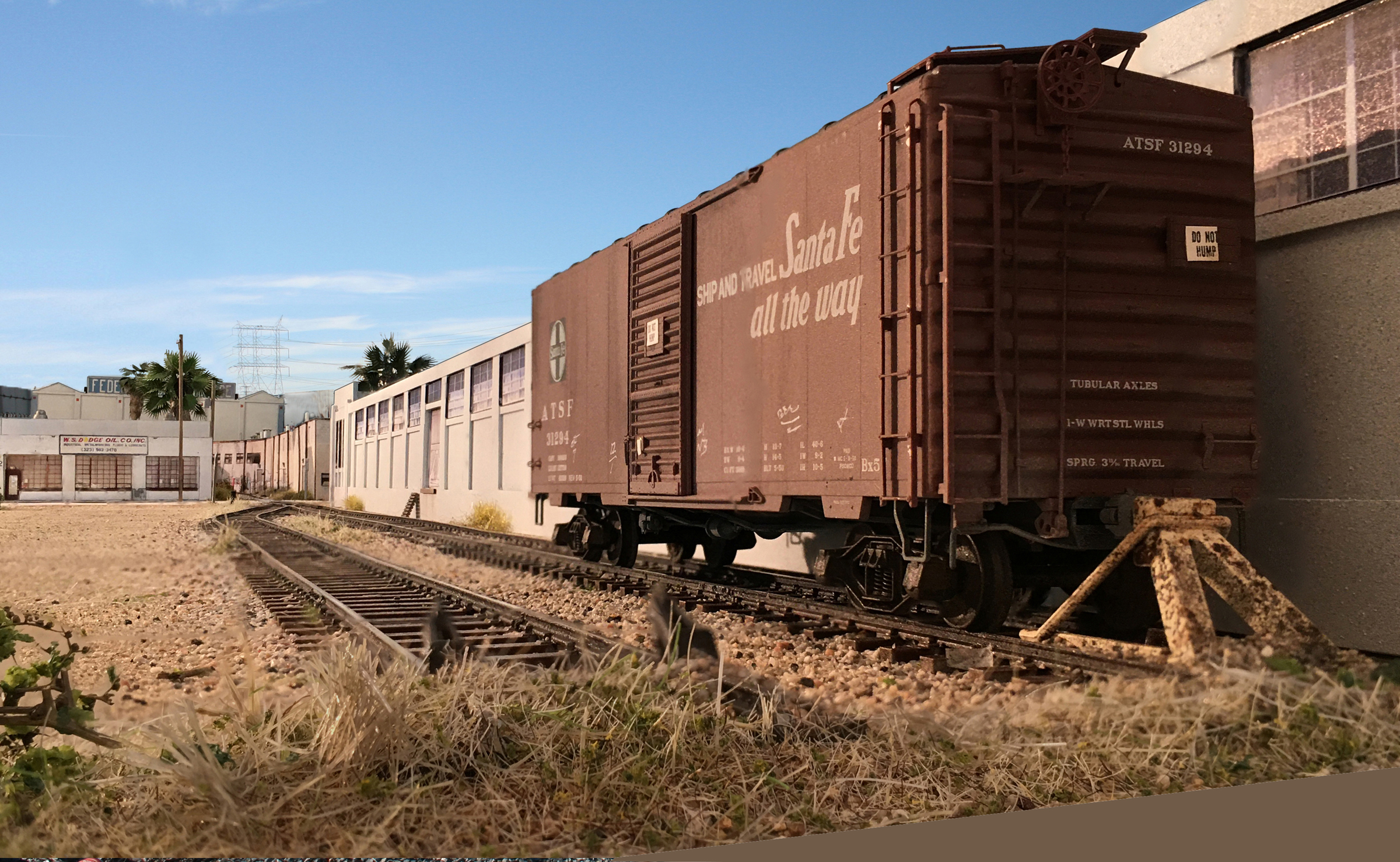
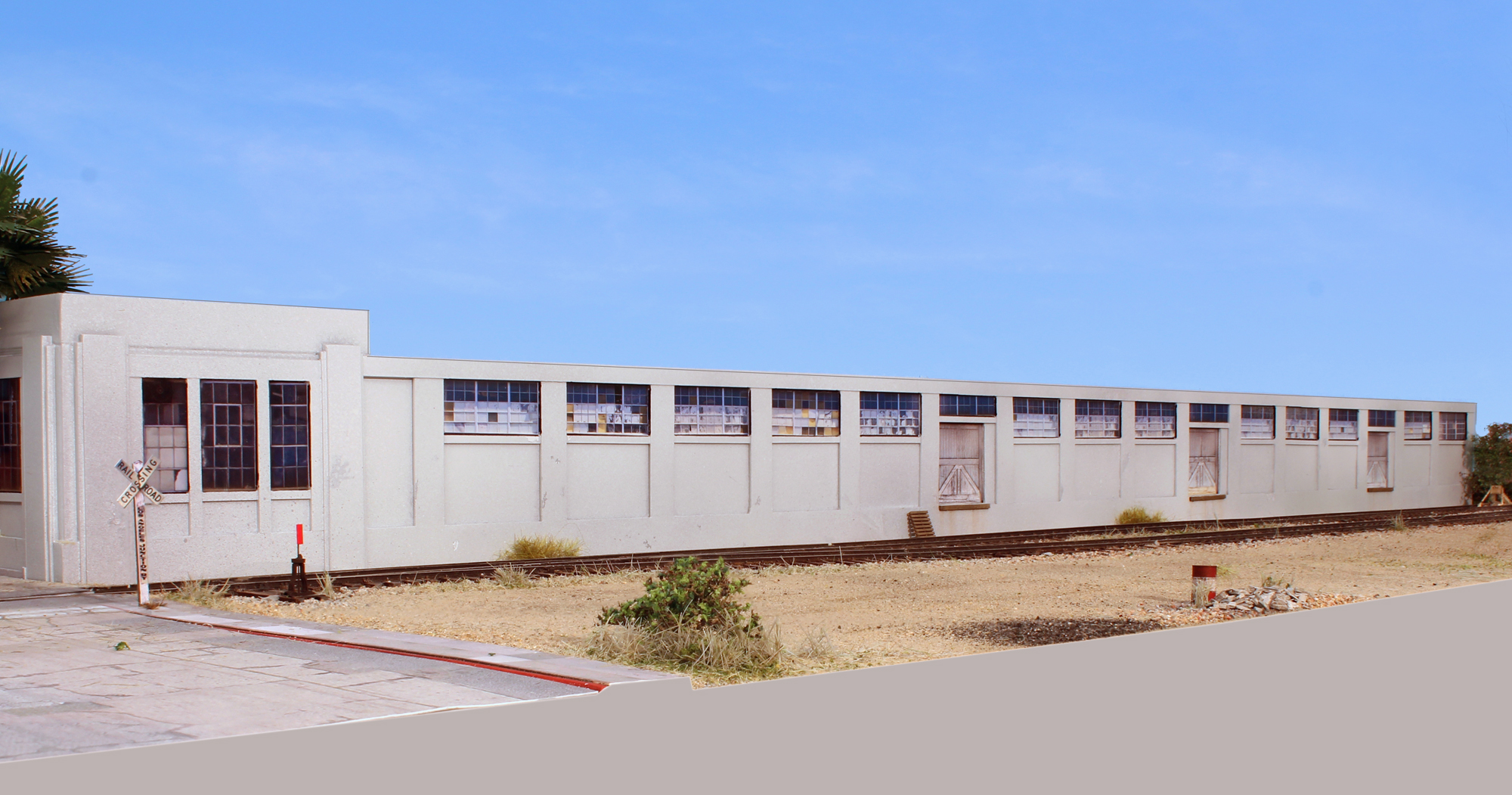
A recent scene on my Los Angeles Junction layout. My current focus is on putting a lot more thought and attention into the background sky/horizon photos that I crop in.


The laws of physics being what they are, it’s impossible to look at our models and have the same sensory experience as actually being at a prototypical location. As humans, gazing down at ten-inch-long pieces of plastic, helicopter style, it will always be…well… it will be like gazing at a collection of plastic. That will be the case no matter how perfectly executed the models are. Putting your head on the layout and closing one eye doesn’t work. Believe me, I’ve tried….many times….with the same result. Until the laws of physics change, and I’m doubtful they will in my lifetime, we need to find a workaround. We need to find a way to experience our world as if we are actually “there”.

Fortunately, such a workaround exists. It’s photography. Mastering the subject is a lifelong pursuit and photographing miniatures comes with it’s own challenges. If you make the effort, the results can be quite rewarding. You’ll be able to experience your work the way you intended. You’ll see it as if you are there.

There are few basic rules you need to stick too that are unique to our hobby.

  1. Keep the camera very low. Helicopter views are fine for documentation but not for what we’re talking about here.
  2. You need to use an editor to remove the background of your layout and crop in an actual sky image. (The exception being if you’re working with something small enough to take outside)
  3. In most cases you’ll be fighting depth of field problems so you’ll need a focus stacking program so that everything is in focus front to back. These programs are inexpensive and easy to use.
  4. You’ll need to set up a light source so you get a few shadows here and there. Without them, the image will look flat and lifeless. All it takes is a simple ten dollar bulb.

All of this is a preamble for the lead image. No matter how much experience we have, we learn over time. There were some aspects of my photos that I wanted to improve. I’m speaking specifically about the sky I crop in after editing out the layout’s actual background.

Looking at the background sky above, there are a few things I don’t like. An actual horizon goes from sapphire blue near the top and then progressively lightens, almost to white, the closer you get to the horizon. Also, the above shot needs a hint of “something” behind the structures where they meet the sky. It could be the tips of trees, maybe some poles, maybe a distant structure. As is, the transition is too stark.

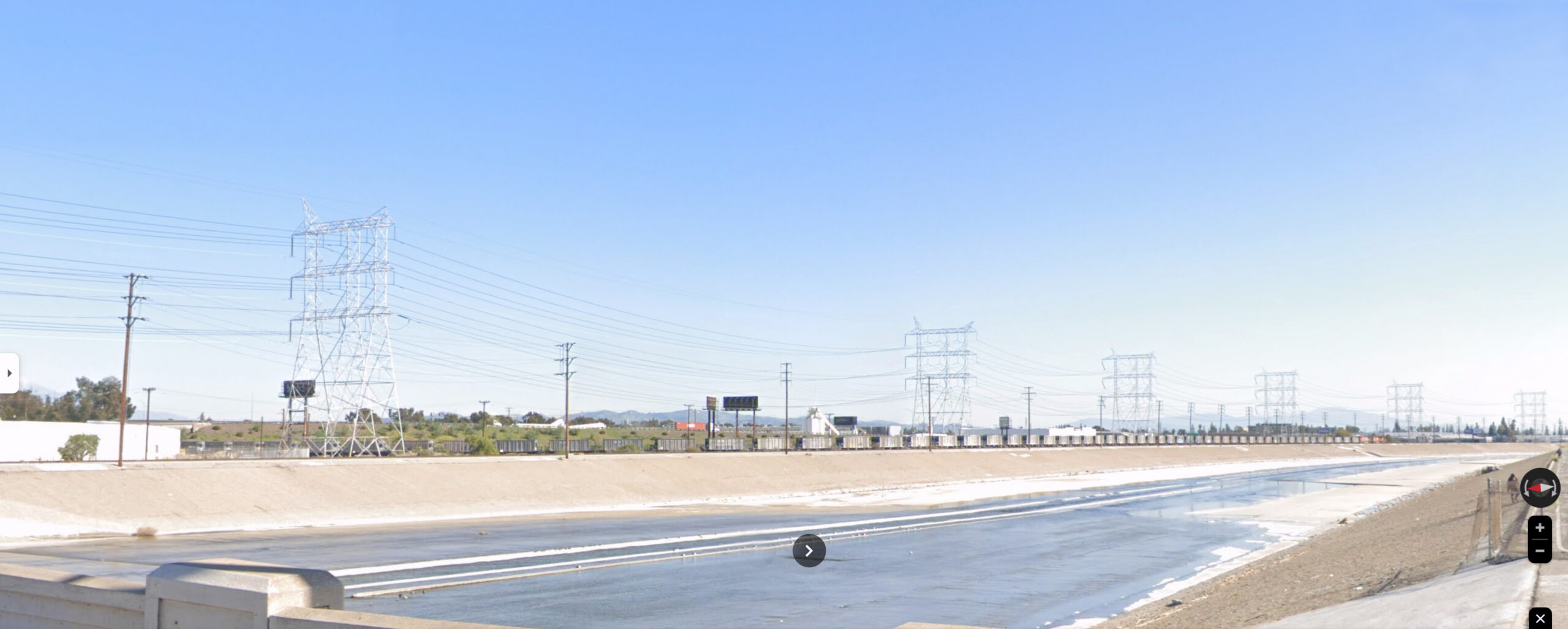
In an attempt to get a better look at the layout-to-horizon transition, I dug out this shot I took over the LAJ’s “B” Yard a few years ago. It makes for a better background for my Los Angeles-themed model photos. Note the white to blue color transition working up from the horizon. Note the signature, but subtle, power line poles emblematic of Vernon. I’ve also come to realizedthat the climate in Southern California is such that white puffy cumulus clouds are rare. Whispy clouds are more the norm. In the actual prototype photo, there are only two towers. I copy/pasted the center tower and inserted it on the left to make a third one. The layer containing the third (left) tower was enlarged slightly so as to make it look closer.

After many years of experimentation, I’ve come to the conclusion that the camera/lens combo that comes closest to what the human eye actually sees is the older, single lens, smart phones. I use an iPhone 6, which I bought on eBay for fifty dollars. I do use an SLR too, but in many cases get better results with the old phones.

Finally, there is composition. It’s a subjective, highly personal subject. Personally, I prefer less dramatic scenes that capture what I’m used to when I’m out rail fanning. When I’m in the field, I only get “lucky” about a third of the time and see an actual train. Most of the time, I’m looking at cars spotted in front of industries and in yards. I find that equally interesting. Three-quarter angle roster shots of passing trains are fine, but are a dime a dozen.

LAJ ops Insights From the Professors

One nice aspect of modeling The Los Angeles Junction is that there are a few retired employees on the forums who are very generous with their time from the standpoint of explaining how they did things. Additionally, there are a handful of highly energetic young videographers who do a great job of documenting the routine of day-to-day operations. I call them the “professors”. Having these resources gives you the luxury of being pretty accurate from the standpoint of operating a layout prototypically. If you listen to what they say and carefully watch the videos, you can really stretch a layout by applying this information.

The photo above shows the Horn Lead crossing Gifford Avenue in LA’s Central Manufacturing District. Unlike Miami, the majority of the LAJ’s street crossings do not have flashing signals. How the heck can you get from point A to B without T-boning three or four cars a week? I posed the question on the SoCal Railfan forum and got the following answer from an LAJ conductor:

“Normally you would just slow down at each crossing, almost to a stop. Most of us would throw flares out at crossing as we approached.

Only a few cars got hit there during my 20 years; you would think there would have been more. “

An active employee from the area added, “That’s a STOP and Protect (until occupied) crossing.”

Here’s an example , a re-post from a few days ago, showing what these guys are explaining.

So, if your layout is only ten feet long, slowing almost to a stop at crossings and using flares is a way to stretch things from a time standpoint.

Unveiling My New Layout

Having wrapped up its work on the LAJ’s Horn Lead, the local crosses District Blvd. on its way back to “B” Yard on my LAJ layout. The Foster & Kleiser Methyl billboards were a signature feature of LA during the early 1960s. It’s removable in the event I want to update to a modern era.


Actually, there is no “new” layout. Rather, it’s a new perspective and tweak on what I already had right in front of me that makes it feel entirely new. Sort of a “Wizard of Oz” moment spurred on by a new perspective and additional prototype information.

At least in terms of architecture, change has come slowly to LA’s Central Manufacturing District. A high percentage of the old Mid-Century Modern and Streamline Moderne warehouses still remain. As a result, you can convincingly model several eras without changing much. Swap out a few vehicles, maybe a structure here and there, and you can nimbly hop from timeframe to timeframe. It wasn’t my plan going in, but I can change eras pretty quickly. My favorites are the Alco era, going from the 1940s until 1974, the CF7 era, going from 1974 to 2009, and the present day. It’s not like I change things monthy but it’s an unexpectedly nice option to have and one that keeps enthusiasm high on what is a relatively small layout. Tied closely to this flexibility is the fact that I made all the structures completely removable, making it easy to pluck them off the layout, store them away, and swap in a different building.

Recently, a few observations and some unexpected new prototype information led me to realize that a commitment to the early 1960s era (at least for now) would yield a layout that is both visually and operationally satisfying, and would transport me to one of my favorite places. The changes would also make the layout more comfortable to interact with.

I realized that:

  1. Removing one structure, Modern Pattern & Foundry would totally open up the look of the layout, expand the operational possibilities, and make things much more comfortable to operate.
  2. Most of the structures in The Central Manufacturing District are essentially plain, cubed-shaped warehouses. The tenants of those buildings constantly change. That means simply by changing a label you can plausibly create an entirely different industry.
  3. A former LAJ conductor recently wrote a long post on the FB SoCal forum where he explained in great detail operations on The Horn Lead. He mentioned that one of the tenants, Longview Fiber (later Southland Box), was very active. Of particular interest operationally was that it was common for them to come in with a train only to find that some of the cars at Longview had not been unloaded yet. That meant they needed to do a lot of pulling and re-spotting. Simply labeling the large warehouse on the short leg of the layout Longview Fiber would effectively stretch the railroad in terms of how long it takes to work it.
  4. In looking at the track chart, I noticed a single spur had no less than seven active industries on it. That meant that I could take one of the spurs on the layout that had been dedicated to just one industry and “re-purpose” it. With a simple label change, I now have that location serving several customers.

Revised Sight Lines, A Game Changer

“Concrete Canyons” were a key element of the Horn Lead, so, in an attempt to be prototypical, I modeled one. Over time, it became increasingly apparent that creating this look was impractical. The foreground building, Modern Pattern & Foundry (on the left), blocked the view of the spur and made coupling and upcoupling in the depths of the canyon very difficult. It wasn’t rail served, was removable, and I’d already laid an asphalt base beneath it. All I had to do was take it off the layout, and the entire vibe and experience improved. I labeled the background structure (on the right) Longview Fibers, a three-spot industry. It’s not often that removing something from a layout improves the design so much.

Here are two views of the opened-up scene. The Palm and vegetation on the right are removable in the event I want to put things back the way they were.


It’s Just A Label

On the long leg of the layout, I have an average-length spur serving a typical cluster of “SoCal Cubes”. The menu of possible tenants for those boxy structures was pretty long. Looking at the track chart, I selected two. It was just a labeling exercise, but doing so tightened up the focus and operational objectives of the layout. Babcock Phillips is a furniture maker. Crown Beverage received adult beverages in N de M boxes.

One Spur, Seven Industries

This diagram from Charlie Slater’s article in a 2003 issue of The Warbonnet provides a wealth of modeling information. Of particular interest was the single long spur on the right that serves seven industries. Copying that format gives you a lot of operational potential from a single turnout.

Using my newfound information from Charlie’s article, this structure was re-labeled and assumed to have two rail-served tenants, Babcock Phillips and Crown Beverage. The model is based on an actual structure on The Horn Lead and was built from photo-laminates using images I took on a railfan trip.

Here’s the updated design, which reflects the removal of the Modern Pattern & Foundry structure and more focused industry labeling to reflect things as they existed in the early 1960s. Nothing has changed in terms of track. There are no additional turnouts. Tightening things up gives me six car spots. From an operational play value standpoint, the number of car spots is more important than the number of industries.


Operations

In the real world, not every industry in a switching district is worked every shift. With only four industries, I may not have that luxury. Traffic was heavier in the ’60s making doing so less of a stretch. A key metric of a plan is your attention span for an op. session. Running solo, my number is thirty minutes.

Each individual has their own take on what procedures and props add to the experience and which feel like a chore. For me, the “time stretchers” I use are stopping or slowing at grade crossings and using the TrainCrew app. to simulate setting and releasing brake wheels. Of the four industries, the most involved to work is Longview Fiber. It’s car-spot- dependent and entails re-spotting if the crew comes on the scene and not all of the outbounds have finished unloading. Despite its towering skyline, Federal Cold Storage saw light traffic. Babcock Phillips and Crown Beverage are traditional loads in/empties out or both.

The Layout Room

Going large, the disease of “I need more…and more….and more” is a constant drumbeat in our hobby. It can be a sloppy, easy out in many cases. The best design is usually the one that is cleanest, simplest, most comfortable to interact with, and gimmick-free. When I find myself drifting towards Rube Goldberg devises such as extensions, complex hinges, and liftouts etc. I know I’m sliding off track and away from a good design. It’s so easy to let mission creep set in. It took some self-discipline, but I intentionally set hard, dimensional boundaries. You can see from the photo that I have plenty of room. After a lot of thought and serious consideration, I decided not to go with a staging extension on the left. I removed, at least for now, the team track extension on the right. The center of the room used to be occupied by an N scale Brooklyn-themed layout. That’s now in a landfill. I now realize that a clean, open layout room on the main floor of my house adds significantly to the enjoyment of interacting with the railroad.

The end result of this is a layout where every element has a clearly thought-out purpose, that spins off thirty minute op. sessions, and doesn’t sprawl all over the room.

Crossing Leonis

A BNSF yard job pauses at the blind intersection of Leonis Blvd. in this Snuffy Cat Productions video.


There are some interesting prototype switching procedures that we can copy that add interest to an op. session without being gimmicky or tiresome. One fascinating example, still employed today, is crossing a busy intersection where the crew’s view is totally blocked and they don’t have the benefit of crossing flashers to stop traffic. The switchback crossing of 12th Avenue on the Downtown Spur is one example (and I model it).

Another example is crossing Leonis Blvd. to get to the team yard on BNSF’s Harbor Sub. Legendary SoCal videographer Snuffy’s Cat Productions produced a great clip of the process. Notice the crew’s communication with the engineer. Note that they have two crew members in addition to the engineer (same for CSX in the Miami example). It’s pretty cool watching the crew stop traffic, throw out the fusee’s, and then signal the engineer that he’s clear.

Fully operational model fusee’s are available from Logic Rail, are easy to install, and allow you copy the practice pretty realistically. Just hit your on/off switch, and the fusee comes on. Procedures like this add time to a session, effectively “stretching” even a small layout.

Here’s the location of Snuffy’s video so you can get oriented. The move is a simple one. They’re just taking a car from Malabar and running it the few blocks to the team yard. Given how busy the team yard has become, and how much traffic there is on Leonis Blvd., it’s surprising they don’t have grade crossing flashers, all the better for us from a modeling standpoint.


I made a short YouTube video showing how this works out in model form.