Model Railroad Blog

The Streets of LA

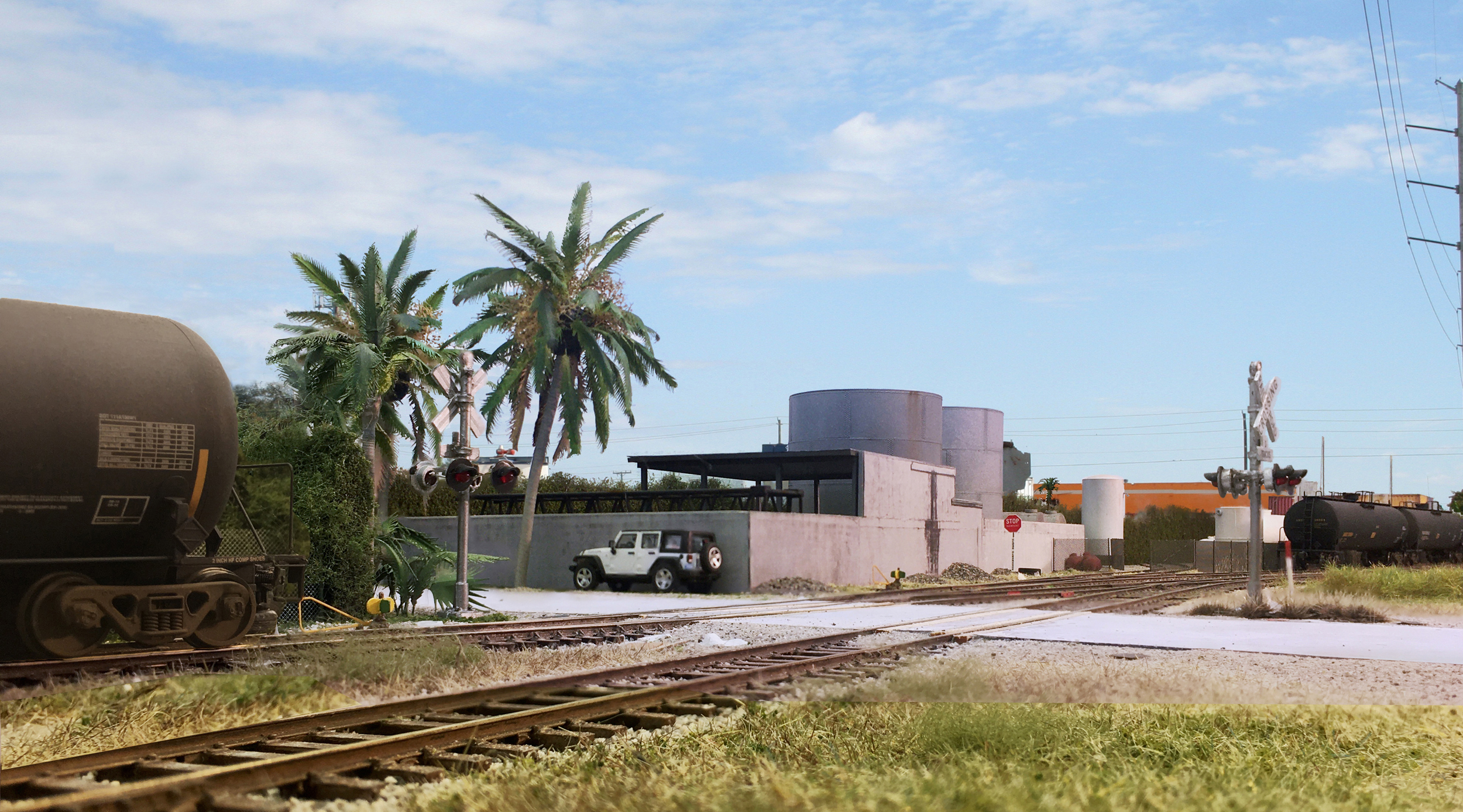
One of the most challenging elements of an urban layout, and one that’s important to get right, is the pavement. You’re dealing with a lot of subtle color patterns and feathered edges. The street behind the track is probably the most difficult model to build on the extension module. The sidewalks curve to the side for one thing. Not obvious in the photo is that the height of the sidewalk ramps down to zero as it gets closer to the crossing.

The street and sidewalks (including ramps) are built off the layout on my workbench from .060″ styrene. I then laminate a photo of an actual street from The Central Manufacturing District using Super77 to the styrene. I added a few dots of thick CA to prevent lift and curling in the years ahead. (To get the image, I stood on the hood of my rental car and shot downward. That didn’t gather a single side glance from the locals. They’re used to craziness in LA!)

Here’s the finished piece. I won’t mount it permanently to the layout for a while since being able to remove it gives me more flexibility while working on the surrounding areas. The image is printed on gloss paper. I then add five or six very light layers of Dullcote applied a few minutes apart. If you lay the Dullcote on too thickly, you’ll get a frosting effect.

Here’s the base image I started with if anybody wants to use it. I photoshopped it so it would fit this specific location.

LAJ 1/31/26 Update

On my laundry list of projects for the early sixties version of the LAJ layout is to add to my rolling stock roster, especially what I call “plain janes”, unpretentious cars that look like they belong. Looking at prototype photos, there were more fifty-footers than forty-footers.

The old Walthers Proto cars are really nice models with a high level of ultra-thin details. The trucks are very smooth rolling. I did some basic upgrades which included swapping in a thinner brake wheel from Kadee, adding Detail Associates cut levers, and replacing the couplers with the Kadee scale version.

When it comes to weathering some lessons learned the hard way are:

-Before you do anything, do NO HARM

-Work in light layers

-Know when to stop

All easier said than done. Going in my goal was to simply knock down the shine and tone down the white for starters. This was done with a very thin wash applied with an airbrush. I filled my airbrush cup halfway with Tamiya thinner and added a few drops of Hull Red. Test the wash strength on a white card NOT the car, again a lesson learned the hard way. A similar wash of Nato Brown was applied to the roof. A wash of Dark Iron was applied to the car ends and around the doors. After looking at the photos, my sense was it “needed something more”. It was soooo tempting to keep going. Judgement prevailed, and I decided to call it a day. I can always add more layers but you can’t undo over-weathering.

LAJ 1/25/26 Update

Along with half the country, I’m homebound due to the massive snow/sleet/ice storm. It’s a good excuse to get some modeling in. It’s been an interesting behavior mod. challenge for me of late, going from a lifetime of “mission mode” model railroad construction to learning to slow down and enjoy the ride. I have to continually remind myself that the faster I work, the sooner I’ll work myself out of projects.

This weekend, I added an extension piece to the warehouse on the base layout, replaced the backdrop mockup with the permanent piece, and upgraded the W.S. Dodge mockup. The backdrop flat consists of three photos stacked on top of each other to give more of a 3D effect.

Here’s the artwork for the door on the warehouse extension if anybody wants to use it. Doors are eighty inches tall, which scales to .92″ in HO. (80 inches equates to 10 cinder blocks as another way to scale things)

One of the members of my Facebook modeling group suggested that I swap in some new trucks from 3D Central on my new Rapido reefer. They came in Friday and are smooth rolling beauties with narrow tread. Between the excellent base quality of the Rapido unit, the new trucks, and Kadee scale couplers, the car has ended up being a real gem.

Wiring the LAJ Extension Module

When I first clipped the extension module in place, I was a little surprised that I got reliable power simply through the rail joiners connecting the module to the main layout. I left things that way for a while, but I wouldn’t call it a best practice standard. As with all turnouts, the frog is dead. That being the case, I was getting stalling when the short wheelbase switcher passed the turnout.

Time to do things correctly. I powered the frog with a Tam Valley Frog juicer and added two sets of 18-gauge feeders. Stranded vs. solid doesn’t matter. The photo above shows the location of the feeders, which I soldered to the bottom of the rail. The Walthers c70 turnouts have a tab for wiring in a power feed.

Here’s a view from the bottom showing the juicer. The module connects to the main layout bus via an XT60, 14-gauge quick-disconnect plug purchased on Amazon.

LAJ 1/21/26 Update

Overall view of the 54-inch-long extension with mockups in place.


Sometimes you need to thrash around for a while to find a path forward that motivates you. For me, answers come from “doing” and testing in 3D. Spending months (or years) drawing sketches isn’t particularly productive.

Two-dimensional drawings tell you very little. Testing in 3D with mockups tells you a lot. I’ve finally settled on a composition that I like, and was surprised by how much the extension module adds to the layout’s operational potential. Here are some progress photos, followed by images of the prototype that will serve as the basis for the structures.

Using “T” intersections at the backdrop interface gets you around the visual landmine of having a street running right into the wall.

Top view of the “T” intersection showing the one-inch gap for the suggested cross street.

The key to capturing the feel of the area you’re modeling is to study it and identify the signature elements. LA’s Central Manufacturing District is typified by boxy, single-story, slate gray or white warehouses such as this one at 5027 Gifford Avenue. The tenants of these structures often changed over the years.

Dodge Oil on Fruitland has a lot of visual texture without being too over-the-top. I’m going to use it as the foreground structure.

The side of this Art Deco structure at 4355 will serve as the background structure at the end of the “T” intersection.

Here’s the edited photo wallpaper file of 4355. Feel free to download and use it.

Aerial view of The Central Manufacturing District facing east.