Model Railroad Blog

Crossing Flashers Explained

I’ve never understood crossing flasher behavior in industrial settings.  Regardless of location when a train approaches a crossing at speed, industrial or main line, the behavior is simple enough.  A predetermined time/distance away the lights activate and the gates drop.  After the train passes a few moments later everything resets to normal.  Not so during industrial switching.  I’ve seen numerous occasion where the train is a few feet from a busy intersection and the lights are off and gates are up.  As soon as the train crawls a few feet the circuit activates, the lights flash and then the gates do drop.  I never understood how this happened.  Did the crew have a switch to turn things on and off?

To the rescue comes Paul S., a professional signal maintainer by trade, who was gracious enough to explain it all.  He writes:

Hello Lance, I just viewed the video you ‘d linked to (skip to the 3:30 mark) of the Downtown Spur Switcher.  The crossing activation system was functioning as intended. This crossing is equipped with either a predictor  or a motion detector for activation. A predictor activates a crossing when a train is a pre-set time from the island — that’s the part of the crossing that intersects with the street. FRA minimum warning time is 20 seconds. We typically use 30 seconds on the (deleted). Regardless of a train’s speed, up to the timetable maximum mph (which determines another parameter we input into the predictor’s CPU), the predictor will always activate the crossing when the train is 30 seconds outside the island. However, if a train stops in the crossing approach outside the island, as the Downtown Spur switcher did while the switch was being lined from main to the spur, the crossing will recover after a pre-set interval as shown in the video. After this recovery, however, the predictor switches to motion-detect mode. As soon as it senses “motion” the predictor re-activates the crossing immediately.  Whenever a locomotive or railcar is occupying the island, the crossing will always activate. The island is a separate circuit of the crossing. “Positive island ring” is an FRA requirement.A motion-detector is basically a complicated on-off switch that activates the crossing regardless of a train’s speed. Once the train is in the approach and the MD senses its presence, the crossing activates. Usually MDs are used today only where speeds are slower and approaches shorter, such as on a branch. If a train stops in the approach to the island, the MD also recovers, and then reactivates upon a decrease in AC voltage on the rails.I’m a signal electronics technician for (deleted)

The Incredible Expanding Layout

Almost overnight I feel as though my layout has doubled in size, all of this without adding a single turnout or section of track.   It’s becoming apparent that I probably have a lot more model railroad than I actually need to keep me entertained.  What happened?  In the past year I’ve learned an enormous amount about how the prototype crews actually go about their job, the speed with which they do it, and the tasks that are necessary.   To the extent that it’s practical, I’ve tried to represent as many of these tasks as possible in model form simply because I  find doing so to be enjoyable.  The end result is it takes me a lot more time to spot a car now than it did last year when I knew less.

Let’s say that the most common style of operation is a solo session running roughly sixty to ninety minutes.  The way most model operators prefer to run is what I call the car movement checklist.  By that I mean the operator runs at a moderately slow pace and the only objective is to place a car in the proper location and check the task off as ‘done’.  It becomes an exercise in ‘finishing the list’ and the better you get at it, the more items you can get done in a given time span.   Many modelers find replicating most of the operational tasks of the prototypical switching crew as boring and therefore they skip them.  No harm in that as the goal of a session is to do it in a way that the owner finds most enjoyable.  That said, operating under this style you can spot an enormous number of cars and work a LOT of industries.  It takes a lot of layout, track, and industries to fill up those sixty to ninety minutes.

However, the flip side also applies and that is what happened in my case.  If you enjoy representing all of the tasks a switch crew performs, it will take you MUCH longer to spot your cars.  The end result is it takes a lot less track and a lot less layout to keep you entertained for those sixty to ninety minutes.  A year ago, I would have switched four or five industries during an hour long solo session.  Now, I only get two done.  Unlocking gates, unlocking turnouts, setting up fusees, stopping at crossings, setting hand brakes, and air tests, all add major amounts of time to the task of placing a car.

Should you model all operational tasks in detail?  It would be easy to come across as self righteous and say this approach is best.    It may not be in your situation.  It’s only the best if that approach increases your enjoyment of the hobby.  If you find it boring, it would be crazy to go to that level of detail simply because somebody stated it was the ‘right’ way to operate.

Since layout size and complexity (turnout and industry count) is such a major planning decision, you owe it to yourself to make a totally informed decision as to what is involved with each approach and which  is most satisfying for you.    Take the time to educate yourself and run a session or two where all of the prototype tasks are represented.  One of the fastest ways to do this is to find a professional railroader to come over and operate with you.  With a little searching you’ll discover that finding such a person is much easier than you would think.  Read books on prototype switching operations.  Watch switching videos on YouTube.  If after a few sessions you find such a detailed operating style is flat out dull, then back off and gradually eliminate prototype tasks until you get the pace you find the most enjoyable.

Just remember though, the more detailed the operational style, the less layout it takes to fill a given amount of time.    If you enjoy detailed operations, at the earliest planning stages you need to come to grips with how long you want your operating sessions to last.  If you’re like most people and generally run solo for an hour or so, you might really want to rethink designing that twenty industry switching layout.  You’ll never be able to utilize its full capacity.  Conversely, the more you move towards the ‘car mover’ style of operations, the more model railroad it will take to entertain you.

Another psychological aspect that factors in is sound.  It’s purely anecdotal, but my experience has been that the higher the quality of the sound system, the slower people tend to operate.  I’ve noticed I’m running at an even slower pace since implementing my headphone sound system.


Modeling When You Have No Free Time

We’ve all been there, or are there now.  You look at your kid’s school and sports schedule, your work schedule, family obligations, and yard work and realize the amount of free time available for modeling is measured in minutes not hours.  It’s not just the absence of free time, such time periods in ones life also leave you with little mental energy when a few spare minutes do show up.  After a long week of work and hours spent commuting, even if you have the time you may not be able to bring the level of focus required to effectively put a model together.  During such periods it’s not unusual for the layout and modeling to go completely dormant for months.

It’s a common life situation and one that can be dealt with without falling into a funk or becoming frustrated.   The problem is as much organizational and psychological as it is time related.

In order to stay engaged with the hobby, and keep your skills sharp, it’s important that to the extent you can, that you get at least  some modeling done every week. Even if it’s only ten minutes, try to get something done no matter how small.  Try to avoid month long stretches where nothing happens.

Here are a few thoughts when you find yourself in this zero time/zero energy situation.

  • Don’t compare your progress to others.  Another modeler’s rate of progress is totally irrelevant to what you are doing.
  • When you are entering a time period like this, it is very important from a psychological standpoint to keep the layout room clean.  Piles of junk strewn about the top of the layout, random boxes scattered here and there, and general clutter subconsciously give you a negative view towards your work.  Clean all tools, boxes, etc. off of the layout surface.  Any item not being used should be put away during these periods of slower progress.
  • Have the self awareness to understand that you have times when you are mentally sharp and focused and times (many times) when you are essentially brain dead.  You want to be totally prepared to get some work in when you have a few moments of ‘mentally sharp time’.  You don’t want to be all set to go and then find you need to spend ninety minutes running to the store to get new blades or paint.   Use your ‘brain dead’ time effectively by doing  mundane but necessary tasks such as cleaning up, getting your tools ready, parts clean up etc.
  •  Have a list of projects you want to get done.  Keep it on the light and easy side.  The projects should be simple but necessary.  Examples include: right-of-way signage, vehicle license plates, signal boxes, electrical poles, small sheds,  laying a few feet of track, etc.  No job is too small to put on the list.  Be realistic and set yourself up for success.  When you enter a crazy period in your life where you won’t have a lot of hobby hours available, it’s probably not the best time to put construction of that craftsman sawmill structure on the list.
  •  Be prepared for open time slots when they do arrive.  Know what projects are on the slate and have everything ready to work on them. This means ALL tools, parts,  and supplies. Throughout the day you have numerous chunks of sub-premium time.  These are periods where you don’t have enough time or energy to get quality work done but time non the less for getting brain dead tasks done.  Sitting around for 20 minutes waiting for your family to get ready to get out the door for an event?  Clean the layout room.  Get your tools ready for the next project.  Use this sub-par time to do prep work so that when premium time does open up,  you can use it one hundred per cent, and entirely on modeling.

NoTimeA

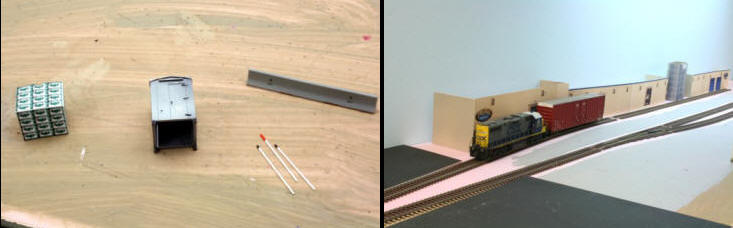
Have a list prepared of small but necessary modeling tasks (left).  Use downtime to be have everything set out for your upcoming project (center).  During times of slow progress, keep your layout surface totally clutter free (right).


  • It’s a cinch by the inch.  If you are working on a larger project try to get at least something done every several days.  It doesn’t matter how small the task.  Building a structure?  Try to get a few windows painted one day, the flashing on a casting cleaned up the next.  It all adds up.
  • Limit internet time.  I know, easier said than done.  Re-train yourself to get out of the habit of checking emails every half hour and firing off ten paragraph philosophical missives to the chat forums.
  • Take kit instructions with you when you leave the house.  Taking your child to the dentist?  Use the time in the waiting room to carefully read the instructions for you upcoming kit project.  If you aren’t working on a kit, such downtimes are good for reading that decoder or DCC manual.
  • If you have a layout, try to get at least fifteen minutes of solo operations in a week.  This could be as simple as doing a few yard moves or spotting a single car at an industry.  What if you’re layout isn’t operational?  If you are far enough along to do so, temporarily tack in ten feet or so of Atlas code 83 flex track and a switch or two to allow to do some running.  You can replace it with more detailed permanent track later.

No TimeB

No project is too small as long as it is a necessary item (left).  Try to get fifteen minutes of solo ops. time in per week, even if on temporary track (right).

 In summary, the point is to stay engaged with the hobby by maintaining momentum and realizing that completion of the smallest of tasks on a consistent basis will allow you do so.

Give it a try.  Pick a small, very simple project you at least want to get started on next week.  It should be something that takes no more than hour total to complete.    Set a goal this week of having everything ready to work on it by the end of week.  This means all tools and parts neatly laid out on your work bench and ready to go.  The following week, work on it in fifteen or twenty minute intervals until you’re done.  If it takes two weeks, instead of one that doesn’t matter as long as you’re getting a little done each week.

Locks

LockSm

 In modern times at least, railroads lock everything.  Switches, gates, derails you name it, nothing happens without the conductor reaching for the keychain first.  To have a model railroad where opening things is as simple as an  instantaneous flip of a toggle strays from the pace of the real world.   I’ve written before that it is a relatively simple task to put locking covers over turnout toggles.  For manual switches, gates, and derails we can simply hang a lock on a hook and  require the crew to open the “dummy lock”.

Locks2

Where I got hung up on all of this was the locks themselves.  To model the locks you really need large quantities of “keyed alike” luggage locks so that one key opens everything.  After months of digging I discovered that such a product does exist.  Enter Padlock Outlet a very well stocked lock wholesaler with excellent customer service.  For a 30% fee (on orders less than $100) they will sell to small fries like us.  Given the very low cost of the locks to begin with, even with the surcharge the locks are very economical.  For my layout I purchased 24, keyed alike, small padlocks part number 4120KA.  I received my locks the day after I placed the order, barely 24 hours later!

Solo Operating Sessions

Whenever I’m at an operating session I invariably ask the host how often they run their layout just by themselves.  The answer is an almost unanimous “never”.  There are number of reasons for this.  I suspect in many cases the layout owner derives most of their hobby enjoyment from building things and operating sessions are primarily an opportunity to socialize.   By not operating their layouts more frequently, and by themselves, I do think these folks are missing out an opportunity to get more enjoyment out of the hobby.  Model railroading is different from our sister modeling hobbies such as military, ship, and aircraft building in that it offers the opportunity, not just for motion, but for realistic motion.

Part of the resistance to having solo operating sessions is probably the all or nothing viewpoint that each session has to be several hours long or it’s not worth having.  Don’t underestimate the enjoyment that can be had from short “mini sessions” that last just twenty or thirty minutes.  Pull out an engine and just switch out that cement plant or factory.  In addition to being relaxing, frequent running will result in the motivation to do more punch list work on minor repair issues and encourage you to keep the track cleaner.  The end result will be a better running layout and more fun for you.   You owe it to yourself.  Set a goal of operating your layout, by yourself, at least twenty minutes every week.