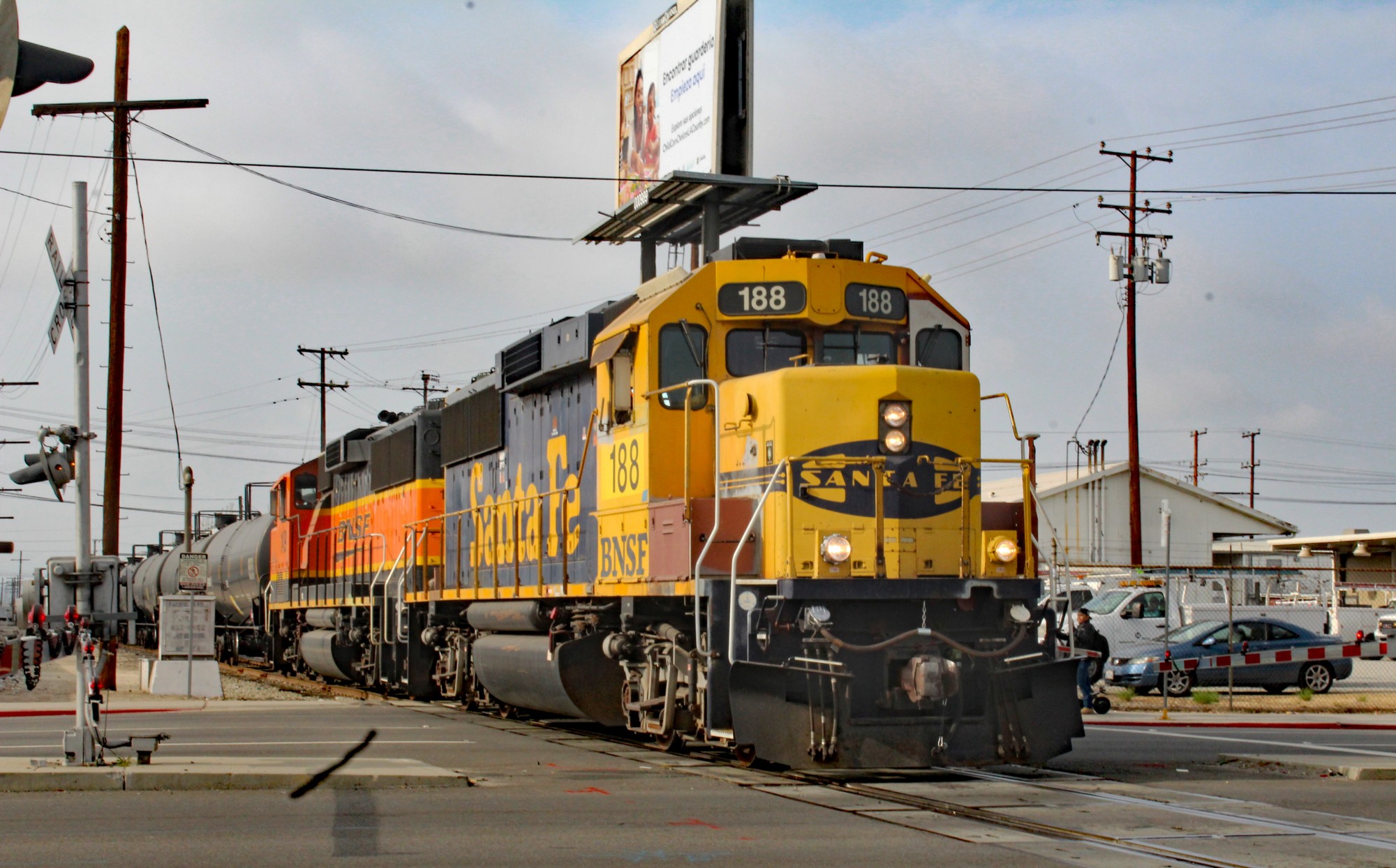
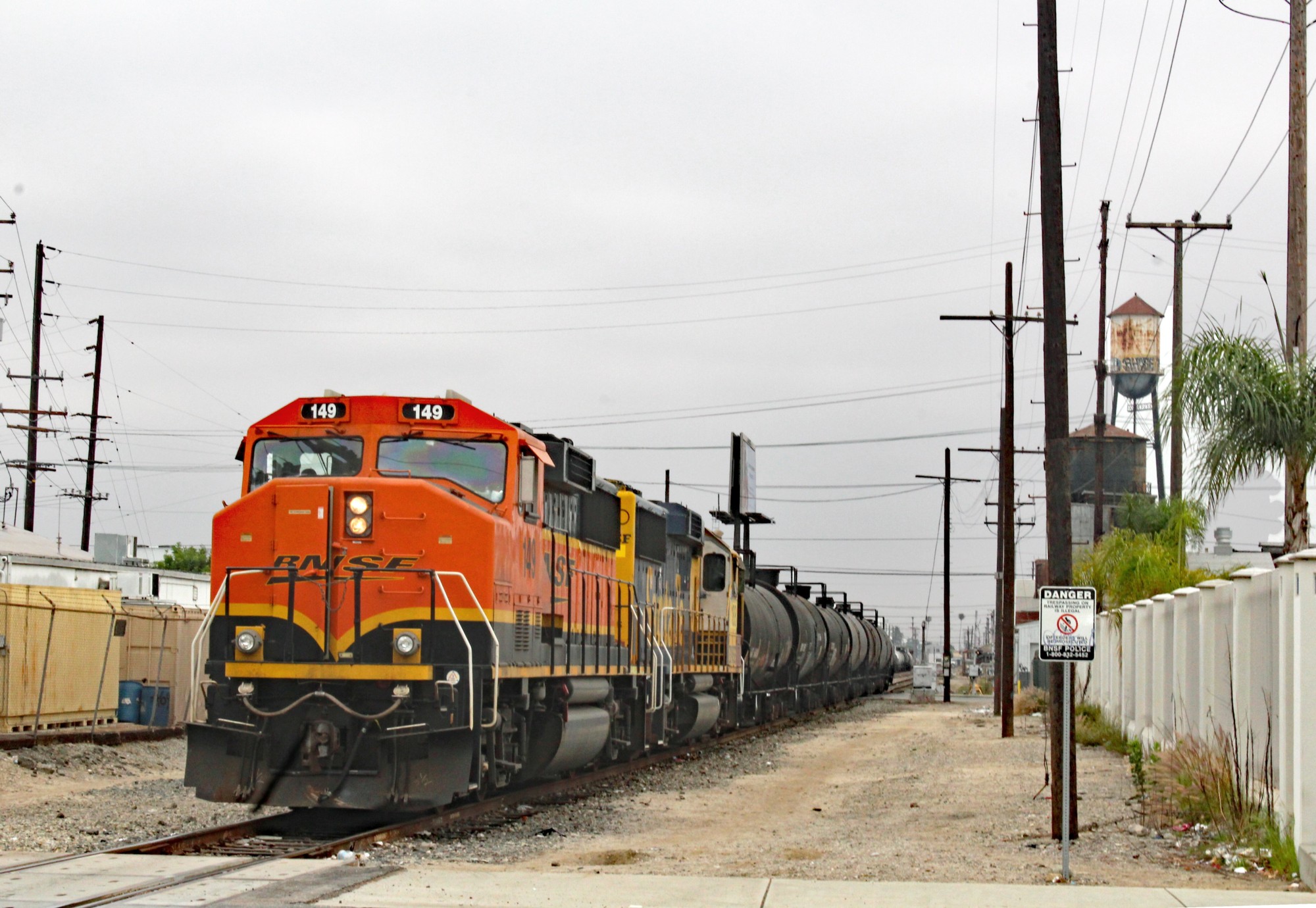
BNSF GP50 #3175 (Athearn Genesis) and BNSF GP39E (Broadway Ltd.) approach District Blvd. for a shot staged on my LAJ layout. Both models are superb runners and finely detailed. Other than new couplers, they didn’t require any additional detail work. The weathering was another matter. Different eras, prototypes, and paint schemes all require their own unique approach. Not wanting to botch the look of some fairly pricey models, I used that self-imposed pressure to take a go-slow, numerous light layers approach to both units. I’ve noticed the lighting in Southern California is slightly different, particularly in the afternoon. While I was editing the image, I shifted the colors a bit more towards red and yellow to compensate.
As I ponder what direction to take for my future modeling efforts, I’m spending my time building up modern-era BNSF rolling stock.
Finally, if you want to see the prototype for this scene, take a look at THIS video and scroll to the 15:54 mark. You’ll immediately recognize the Nathan Anthony structure in the background.
Matt Sturgell and Kelly Regan guide the local off the CSX main onto The Downtown Spur at the start of the op. session.
It’s been far too long since I’ve had an op. session on The Downtown Spur. It should come as no surprise that getting off one’s fat ass and actually inviting people over has a productive outcome! Kelly Regan and Matt Sturgell came over on Sunday for what I’d consider one of my better sessions.
I’ve been giving a lot of thought over the past few years as to how to make these sessions a better experience for guests, more realistic, and just generally a smoother affair overall. The root of the problem is the hobby operations culture that we, as hosts, follow,….myself included. Hosts don’t want guests to be bored. They want to show off their hard work in all of its glory. In our benignly misguided attempt to do the right thing, our solution is to create a session full of gimmicks, complexity, and puzzles. The hope is that the guests will find this entertaining. News flash, they don’t. Newbies are totally disoriented when they arrive in terms of geography. Essentially, what happens is that we hosts give our guests a throttle and an arcane switch list and say, in effect, “figure this out, it will be soooo much fun!” Throwing somebody in a pit and watching them scratch their head and try to crawl out of such pit isn’t cool. It isn’t realistic either.
Between discussions with Kelly and my own thoughts this is what I’ve done.
-First, the layout owner is the conductor. He has the switch lists. The guests don’t see the paperwork unless they want to (and….big surprise, they really don’t want to see it). The guests handle the throttle, coupling, and turnouts. That, in and of itself, solves a ton of problems.
-Second, limit the session to 90 minutes. That’s quite enough for most people.
-Follow the prototype example and have the train correctly blocked at the start of the session. No sorting and re-ordering of cars mid-session.
-Limit the number of artificially difficult switch moves, such as digging a car out on a spur from behind several others. This does need to be done sometimes, but it’s the exception, not the rule.
-Don’t switch every industry, every session
-Not every industry entails a “loads-for-empties” swap. The larger ones often do, the smaller industries generally do not. I caught myself mid-session with one of these and plucked the offending car off the layout and removed the move from the switchlist. Smaller industries generally entail picking up an empty and nothing more or spotting a load and nothing more.
I’ve experimented with props over the years. My opinion changes back and forth. Right now, I skip most of them. I do still use the operational fusees and gates. I don’t use the locks on the turnout throws (but may in the future). Prototype operations are marked with frequent pauses. I handle this by explaining to the guests at various junctures what would be happening (conductor walking, air tests, etc.), but don’t get too hardcore about it. The one thing I’m a stickler for is keeping the running speeds realistically slow but this generally isn’t a problem with most guests.
Click HERE for a short YouTube clip of the end of the session.
Although these tank cars look identical, they are not, and therein lies a lot of operational potential. Looking up the placards, I could see that as a minimum, we have diesel fuel, ethanol, and carbon disulfide.The cars need to be blocked in the yard and spotted at specific locations within the Exxon Mobil complex.
I’ve written frequently about the concept of car spots and the fact that industries that are car spot dependent effectively “stretch” a layout. Food industries are the classic example. Hoppers get spotted in one location, vegetable oil tanks at another, boxcars at still another location. Even a small industry can take a while to switch, and therein lies the fun.
Taking that concept further, the cerebral chess game notches up when you have an industry where all of the cars “look” the same but are not. Corn syrup, for example. That row of seemingly identical tank cars each contains a different grade of product. In order to prevent contamination, each one needs to be spotted at a different unloading pipe. As an operator, you really need to pay attention since you don’t have differing car types to help you tell the cars apart.
On my recent trip to LA to rail fan the Harbor Subdivision, I noticed an unusual amount of activity related to blocking the tank cars in the yard. All were associated with the nearby Exxon Mobil plant. That seemed odd. I “thought” all petroleum tanks were the same. I’ve since learned they are not, which explains the constant sorting and blocking.
Bing Birdseye view of the Exxon Mobil facility served by BNSF’s Harbor Subdivision. From a modeling standpoint, you could probably omit much or all of the complex piping and still maintain the operational play value.
Blog reader, Paul D. works in, and models the oil industry. He was exceedingly kind to take the time to educate us as to what’s going on. Paul writes:
Hey Lance-
I was reading your blog about the Harbor Sub ops and thought I might be able to provide some insight into the XOM operations. I’ve worked in the oil industry for about 12 years now, specifically in oil refining and chemicals manufacturing; I also have a colleague that worked at similar sized lubes blending facility that I mined for information.
At least part of this facility is a lubricants blending plant that likely has some degree of rail service. It’s a little hard to tell but the presence of the larger tanks nearby and the way the piping is routed leads me to believe that this spur may also supply something to the gasoline terminal that’s technically across the street. The number of cars and the amount of switching activity you described seems a bit excessive for the lubes plant only, but could make sense as part of a supply to a gasoline terminal (unless my mental model of the throughput of this lubes plant is way off).
One way to piece this out is if you have any pictures of the DOT hazmat placards on the tank cars bound for XOM – if you see large car blocks of any 1203 (gasoline), 1202 (diesel), or 1987 (ethanol) then they are supplying that terminal through this facility. I’ll drop you some details of rail operations for both so you can pick and choose what you think gives you the most value here and what matches your observations from actually being there – I’ve gone back and forth on whether or not this rail spur serves the fuels terminal, but you should hopefully be able to deduce that from your pictures. Either way, one or both options will give you plenty to work with.
Fuels Terminal:
Most fuels terminals are supplied by pipeline; if they’re getting rail service it’s either because there’s no pipeline and/or they’re getting specialty grades (the refinery I work at in the US makes and ships Canadian grade gasoline via rail, for example) or additives (e.g., ethanol) via rail OR possibly they’re shipping in other biofuels/biodiesel for blending/distribution – again, UN numbers on the DOT placards on the tank cars are you friend here. Regardless of what they’re taking in, it’s likely to be car spot dependent – different gasoline grades may use the same import spot but the cars would all have to be blocked together; if they’re pulling in any combination of ethanol/gasoline/diesel, each of those blocks would have a unique car spot. Guessing most of this would be pre-blocked at the yard, consistent with your observations so some yard sorting possible here if shipments of ethanol, for example, came in via different trains.
Lubricants Plant:
In general, these plants will take in lubricant base stocks (likely from the XOM refinery in Baytown, TX or perhaps purchased from a third party) as well as any additives. It is likely that a decent chunk of the rail traffic into this lubes plant is loaded tank cars with base stocks and then empties out. Most base stocks manufacturers will have a large number of base stocks available; indeed a look at the XOM website indicates many different grades available, ExxonMobil Basestocks & Base Oils. Unloading for different base stocks is likely car spot specific. The overhead shot from google maps at least looks like there are multiple hoses on the ground near the tracks and there are also a LOT of unique tanks, which further suggests a wide variety of feeds/products at this facility; this is not that different from corn syrup in most regards.
Most product is sent out either via bulk truck (note that this location appears to also have a truck rack next to E 37th street) or is packaged and shipped out via trailer. But here’s where it gets a little fun – my buddy told me that some customers were large enough to take rail cars of finished product if they had their own tanks of sufficient size. Another fun wrinkle is that occasionally they would ship interplant to another XOM facility if that facility was having issues and were at risk of shorting a customer. So you could also have some unique product car spots for larger shipments to other facilities as well or one-off variations in the ops.
Overall, a plausible operating scheme for this facility could be:
-Regular/frequent (daily):
-To the lubes plant: Loaded base stocks in, multiple grades (car spot specific); empties out. Multiple cars at a time.
-To the fuels terminal (if rail served from this location): loaded tanks in, gasoline/ethanol/biodiesel depending on what DOT placards you see. One or more blocks of cars for each product type, each block would go to an appropriate unloading spot.
-Intermittent rail service (few times a month?): empty railcars in, loaded finished products out to larger customers (would probably be regular and of the same blends) – probably a car or two at a time, and also car spot dependent as you wouldn’t want to cross contaminate finished product.
-Infrequent/one-off: interplant shipments, could be either intermediates or finished products. Probably one or two cars at a time.
Since everything is car spot dependent, you can still play the same game of ‘car is currently unloading, needs to be pulled out and respotted at the same spot so they can finish,’ and the number/type of car spots you select can be fully dependent on how much space you dedicate to this facility.
Other realistic loads you could add if you felt like a bit of unconfirmed modelers license:
-Solvents or other reagents (things like alcohols, glycols, caustic, acids, other additives) – could be plausible if the plant was equipped to further modify the base stocks or possibly making their own additives on site. Would give you an excuse to break up the parade of 23K & 25K tanks with some 20K or 16K gal cars.
-Equipment via flatcar (mixing vessels, tanks, piping, etc.).
…and in a subsequent email Paul added:
Ethanol and diesel make sense to me – I’d bet those 1202’s are actually biodiesel. They have to rail both to terminals since there’s no pipelines for either of those products and CA has some pretty strict renewable fuels mandates. Looks like the longer cuts for the fuels terminal may go to the rear of the spur, so possible they have to move cars for the lubes plant out of the way to pull/spot for the fuels. Seems like an interesting arrangement to me – if I had to guess, that lubes plant has been there for awhile and at some point in the last 10 – 20 years when the renewable fuels mandates really kicked in, the terminal made an arrangement to use the spur for unloading biofuels. Should make for interesting operations!
Weathering this Genesis GP-50 was a two-weekend, twelve-round cage match, complete with dodging a few near disasters.
A masterfully weathered model can be a visual game-changer for any scene. However, anybody who’s delved into it can attest to the fact that it can be a very humbling experience, no matter how long you’ve been at it. I made my first attempt five decades ago and can say with confidence I’ve botched more models than anybody reading this. Even now, most projects are still a battle that takes total focus. Rather than do a tutorial, today I thought it would be helpful to discuss overall strategy. All the tips in the world won’t help if you don’t have your eyes wide open as to the big picture.
First and foremost, the number one error is taking things too far, overdoing various effects. Go into every project repeating the mantra “light touch, light touch, light touch”. Work in layers.
There is a tipping point with any project. Be very, very clear about that before you even start. You build light layers, one on top of each other, with the goal of reaching the artistic promised land. You march step by step towards that end. However, if you go one step too far, if you go beyond the tipping point, you’re totally screwed. Backing off an effect that was too heavily applied is very difficult, usually impossible. One crucial thing I’ve acquired from decades of experience is this. As I’m applying layers, I’ve developed (through very expensive lessons) an internal alarm that goes off and says, “STOP!! You’re approaching the tipping point. Take a break. Go mow the lawn. Look at this with fresh eyes in a few hours or in the morning”.
A crucial skill in weathering, and it’s not easy to master, is one of color transitions, of feathering the edges of your lines from one color to the next. The difference between a master and a journeyman often comes down to this. You want very subtle, feathery transitions, not harshly defined lines.
A hallmark of Tom Johnson’s work is his mastery of color transitions and how he feathers his lines.(T. Johnson photo).
Be very aware of the importance of inserting contrast at your panel lines/rivet lines and doing so with ultra-thin lines. Military modelers are masters at this. (Google Tamiya Panel Line Paint and watch some of the YouTube videos). Contrast is vital but you need to be subtle about it.
For key steps in any project, always, always dial in your color mix and techniques on a sample, NOT the model itself. Ruining several three-hundred-dollar locomotives will drive this point home.
Work from photos and REALLY study them. Understand what you’re looking at and come up with a strategy before diving in.
Over years you’ll develop a critical skill, and it’s painful to learn. It’s one of becoming adept at recovering from disasters and correcting errors.
As you embark on this lifelong journey, critical skills to learn are: fading dark colors, rust streaks, paint streaks, and paint peel. Learning to use ALL color mediums (enamels, acrylics, oils, inks, pencils, and powders). Gain experience in how various chemicals react with each other, especially acrylics and enamels.
An overhead view. Brushing rubbing alcohol over a Dullcote finish creates the frosting effect. Note the contrast in the grills obtained with dilute India Ink.
In summary:
-Use a light, light touch. Be hyper-aware of not overdoing the weathering.
-Work in layers
-Be aware of the “tipping point” and the consequences ($$$) of going just one step past it.
-Be aware of the importance of panel line contrast.
-Practice subtle color transitions and getting away from harsh lines.
A very recent (April 2025) Google Streetview image of Arrow Reload Systems. Note the variety of car types. YouTube videos filmed on other days show a large volume of flat cars carrying steel products.
Prompted by a recent email from a blog reader, I thought now would be a good time to discuss operations on the Harbor Sub. (north end). Let’s start with the lay of the land i.e. an aerial of the prototype, and the layout track plan.
The old Harbor Sub was split into several sections. I’m modeling the northern piece shown in the map above. Splitting off from the main at Harbor Junction, it’s about a thirty-minute walk to Malabar. There isn’t really anything noteworthy south of Malabar; the line runs a mile or so and then ends in the dirt. BNSF’s massive Hobart Yard is about a mile to the east of Harbor Junction.
Now, getting to the heart of the matter, operations, blog reader Mark H. recently emailed me with the following questions about the operating plan for a future Harbor Sub. layout:
” I would appreciate some insight into your operating plan. Would the incoming freight train be staged straddling the main line/entering the Harbor Sub, then proceed to Malabar Yard to drop cars and pick up outbounds and return to the Junction, with a local servicing the industries with pull and shove moves? Or would a train be staged in Malabar Yard to service local industries, with the main/Harbor Jct. functioning solely as a visual display? I would also be interested in knowing contemplated train lengths and whether trains would feature one or two units.”
I’ll start with the easy ones first before delving into operations. I would run two locos per the prototype. In reality, the trains are quite long. I don’t have that much space, so I’d probably limit them to five to eight cars or so. In most (but not all) cases, I’d probably start a session with a train incoming from Hobart staged on the bridge. Now getting to the bigger question on ops.
I classify industries on a branch like this as follows:
-Massive industries that are frequently switched (often daily…or more). These provide the bulk of the revenue for the branch. In the case of the Harbor Sub, that would be Exxon/Mobil.
-Mid-size industries that are fairly regularly switched and often have the added interest of being car spot dependent. That would be Arrow Reload.
-Small industries that see fairly consistent service such as Dar Pro.
-Small industries that get some switching but rarely, such as Pabco.
Getting to Mark’s question, most of the activity on this line appears to be related to moving cars between Hobart Yard, Exxon/Mobil, and Malabar. I’m not up to speed on how cars are spotted at Exxon/Mobil nor am I clear on what’s going on with incoming/outgoing loads vs. empties. (If anybody knows, drop me a line).
A typical op. session would start with a train spotted on the bridge heading south. Dar Pro would be worked first. The next trailing point would Exxon/Mobil where I would expect some form of load-for-empties swap. After reaching Malabar, the units either tie up for the day or run around the train and perform some significant blocking, the nature of which I’m not clear on. There are also frequent back and forth transfer runs to Hobart the nature of which I’m not clear on either. Certainly, Hobart is the eventual start or end point for every car.
On a separate day, cars for Arrow would be blocked in the yard and the shoved down to the facility to be spotted. On rare occasions a single car might be spotted at Pabco.
Here’s a timeline from my recent trip that might help.
I arrived at Malabar at about 3:45 pm on Wednesday, May 28th, and things were totally quiet. The two units weren’t even idling. I gather they are semi-permanently stationed in Malabar to work the Harbor Sub. Note the long strings of tank cars related to Exxon/Mobil. I spent an hour documenting the area and then drove to the north end of the line.
At end of the day that day, Wednesday the 28th at 4:45pm, I went back to Malabar. Both locos were gone! A few minutes later, I saw them heading back to the yard with a cut of cars from Exxon.
I returned to Malabar at about 9 am the next morning (Thursday May 29th) to find the Malabar yard units working hard at classifying tank cars. Why were they sorting them? It was a pretty extended sequence that blocked several busy intersections for long periods of time.
Shown above is a Bing Birdseye image showing a lone boxcar spotted at Pabco. Google maps shows the same. I’m not sure if this industry is still active, but the switch is still there. It took some digging but the Google aerial time stamp was February 11, 2024 which wasn’t that long ago.
A Google aerial view of the Exxon/Mobil facility. I’m totally ignorant as to the nature of the place and the car flow. Whatever happens car blocking at Malabar seems to be a crucial part of their operational scheme.