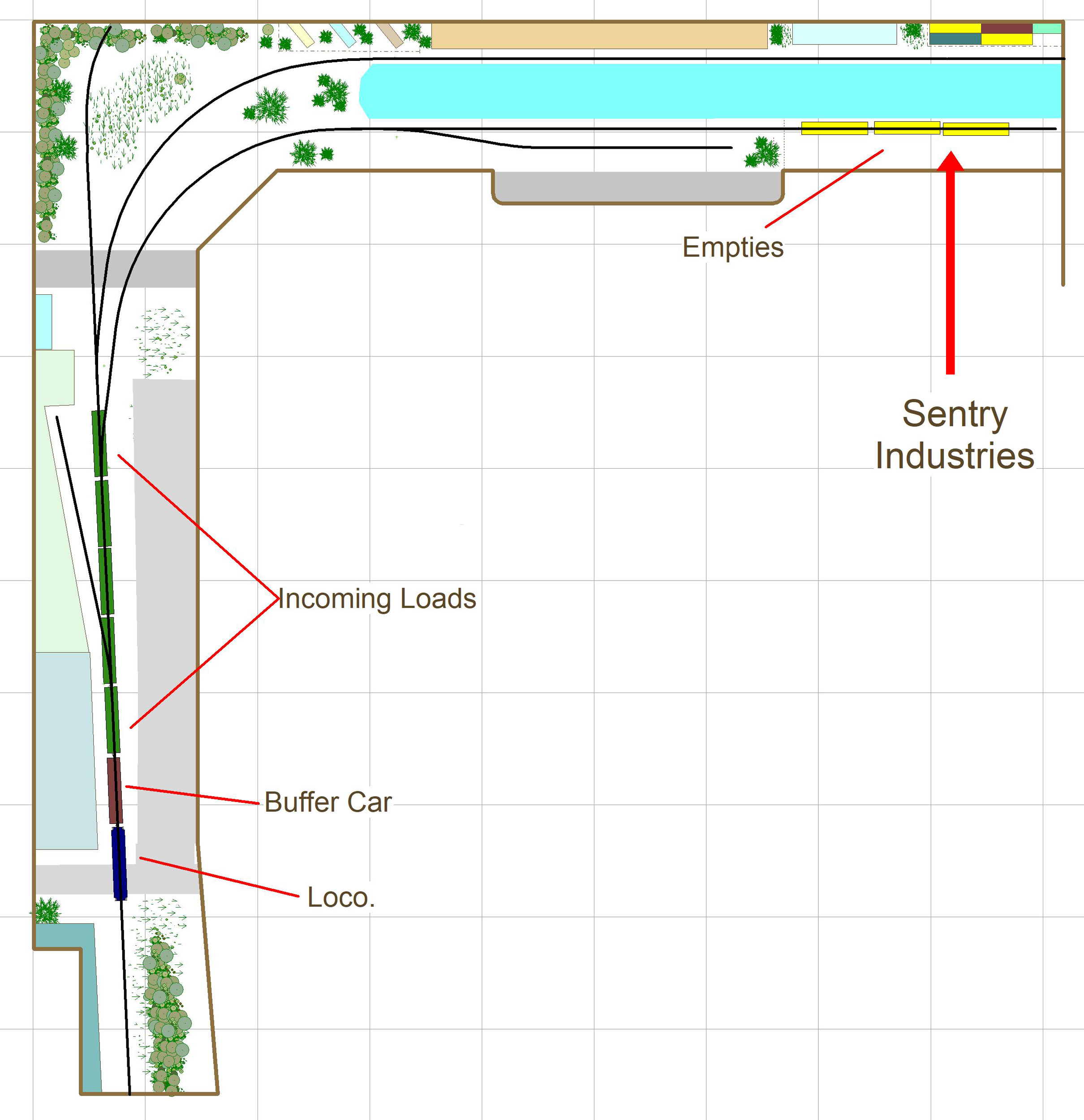
The graphic above illustrates the work done on the video. It’s a pretty simple loads-for-empties swap. Even so, it spun off a good twenty or thirty minutes of entertainment value.
I recently uploaded a new operations video highlighting a solo session working Sentry Industries on my East Rail layout.
I intentionally left it somewhat unpolished and uncropped to show what a solo operating session on a layout can look like. Specifically, it shows how a highly plausible and relaxing session can be designed without resorting to tricks, gimmicks, or artificially inserted “gotcha’s”.
“Stretching Your Layout”
Setting up this whole sequence spanned a few weeks and brought home the fact that there are ways to “stretch” our layouts without adding more square footage to the bench work or adding more turnouts. By “stretch” I mean expanding the entertainment value.
-Research adds fun. I started by watching the two or three videos Tolga filmed of the prototype sequence. The advantage of being a prototype modeler is that you can just copy what they’ve done. I also learned from studying the videos that the tank cars actually had their contents labeled on the sides of the tanks. I originally thought Sentry only handled one incoming commodity, chlorine. They actually take four distinct chemicals. I was pretty lean on my knowledge of tank cars, and it was fun to learn more about them, as well as the various hazmat labels and what they mean.
-Slow running speeds extend time. Watching the videos reinforced how slowly they run. Maybe because the cars involved are all hazmat? Running at 10mph creates a session that is 3x longer than if you run at 30mph.
-One advantage of rail fanning switching operations in person is you pick up on a lot of things that you wouldn’t notice on a video. Specifically, how long the pauses in the action are, often five or ten minutes between motion sequences. The guy on the ground has to do a LOT of walking. These pauses are cropped out of rail fan videos for obvious reasons. It’s not practical to model these full length, but when I’m having a solo op. session, I make a point of pausing now and then and visualizing what the crew would be doing: setting and releasing hand brakes, opening and closing gates, unlocking and throwing switches, and walking, walking, walking.
-After researching the tank cars, I realized I needed to buy some new models to more accurately represent what I saw in Tolga’s video. (I still have more work to do in this area). It was fun to paint and weather the new cars. Again, stretching the layout.
-Smaller layouts like this give you the luxury to super detail your scenes without feeling pressured to make progress.
-Models can be built to a degree of details spanning a spectrum from mock-ups, out of the box, good enough, to highly detailed. Small layouts and scenes like this allow you to move from “good enough” to highly detailed.
Grade Crossings
Between being in the field and watching videos I’ve noticed a lot of variation in how the crews handle grade crossings deep within industrial parks. It seems to come down to how long their line of site is, and how much vehicular traffic there is. In some cases, they stop completely at a crossing and then crawl across. At other times, they slowly roll through without stopping. In the case of a “roll through,” there is a crew member on the footboards or in the street with a radio giving the all-clear sign to the engineer. If you look at my video, you’ll see that sometimes I stopped at the crossing; sometimes I did not.